I am still at it and do daily exercises, though a lot less than before. I know I still have deficiencies, particularly with kanji that I should work on but my motivation hasn’t been up to speed in recent weeks.
However, I’ve tried bit by bit watching some easier to comprehend anime without subtitles, forcing myself to listen to it which I trained myself to do less over two decades of watching things with subtitles. This has been going okay, but I catch myself listening, then translating what I heard to german or english to interpret it. This is of course an unnecessary step that I for example do not do when reading or watching english media despite it also being an acquired language. I can just “think” in english. Perhaps this will fall away when I have more practice but at the same time it feels like a big hurdle at the moment.
Mmmm, that’s really interesting. Here the same verb “roll” means something very different based on the subject that is doing the rolling and also the thing being rolled. A person can roll a car, roll some dough, roll some dice, or rickroll someone, and those are all different. They do have one thing in common which is some sort of circular/spiraling motion that is also going forward. I’m sure linguistic experts know all about this already, but I do see now how other languages have different verbs for these different activities.
The meaning of phrasal verbs (verb + preposition) is rarely connected to the two parts. “Take out” and “take in” have several (or dozens of) different meanings and none of them are opposites. “Take in” and “take out,” “take up” and “take down,” etc. English spelling has a very loose relation with pronunciation, as do multi word units with meaning.
English is, indeed, a very silly language, and we can blame the French for this.
This reminded me of my school days when I had taken French for 3 years and it did not seemed to be a twisted language as people curse about it right now. Basically if you start learning a new language from the very beginning, it will easily go through you. I still have 2 of the books somewhere. May be I’ll resume my learning again.
I need to re-start my german re-learning in duolingo. My german au pair’s mother is coming to visit in September and my highschool german is more rusty than anything else at this point and she doesn’t really speak english at all.
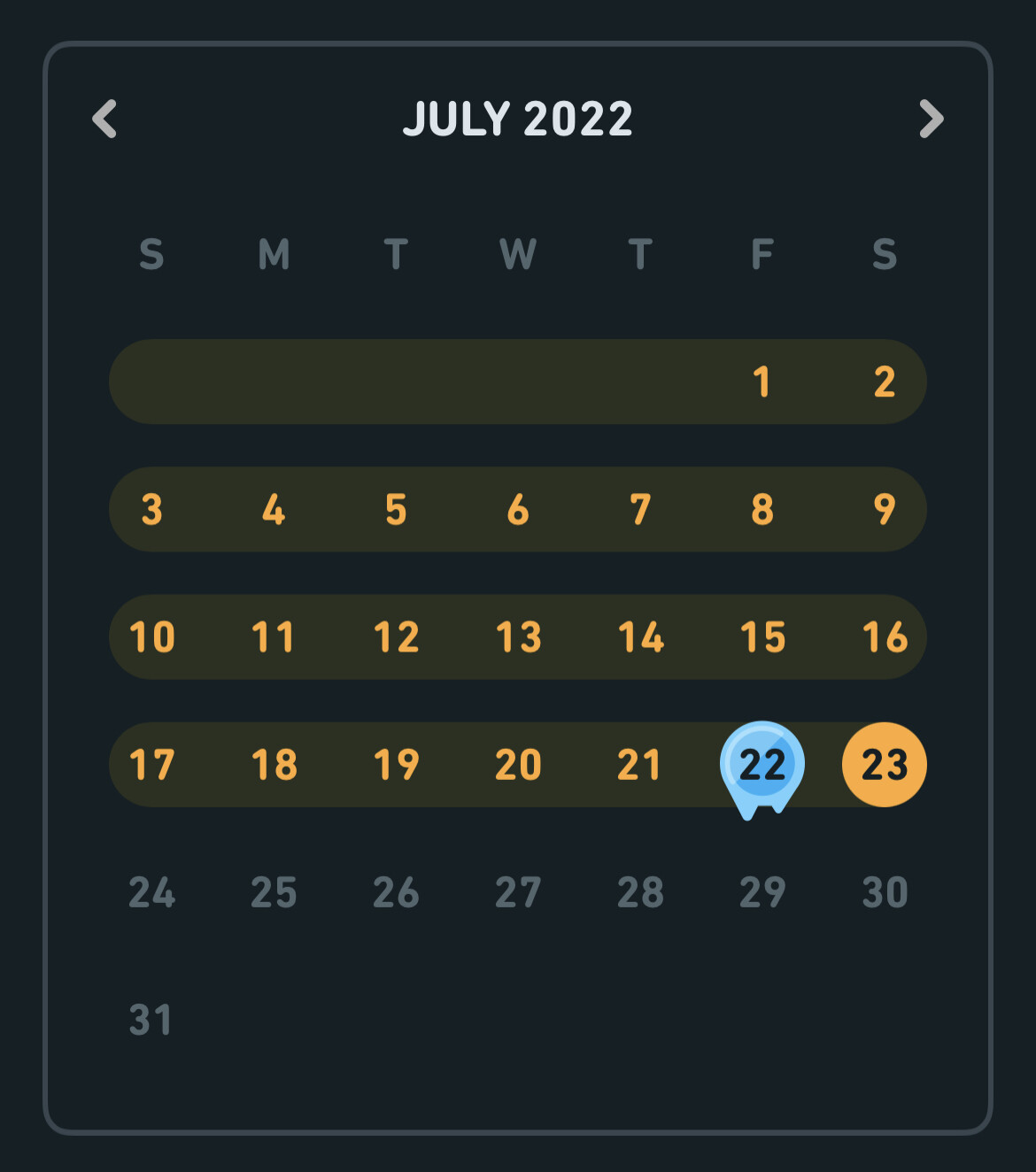
Turns out I had a “streak freeze” bonus so it pretends I didn’t miss a day when I totally did. The product team obviously know that a missed day (due to illness or unforeseen circumstances) can kill momentum and motivation, so a way to freeze the streak for a few days makes people come back.
Yeah, you get basically three chances - two streak freezes, and one streak repair(Within 72 hours of breaking your streak.) It’s genuinely a really clever feature.
I have unfortunately been rather lazy in the past half year or so because I was quite honestly burned out with work and other things. I still did some exercises through duolingo daily, but that was more rote repetition than anything substantial. I want to do more.
My first target is to get better at reading Kanji, which I unfortunately rather suck at. To do so I want to read more japanese deliberately. I thought a good target would be some manga. I have now lined up the japanese versions of Yotsuba&! and Teasing Master Takagi-san. The problem with those two is that I already know basically what is going on in them as I have read like 12+ volumes of each in either english or german. So I am looking for something I haven’t read yet. It should be
good
have furigana in the japanese text
don’t contain too many technical terms or terms specific to the series
I of course want to get to the level where I don’t have to rely on furigana, but they help when looking up kanji I don’t know. Hopefully I will also get to the point where I can take on series with more complex lingo in them.
I have also tried some 4-koma series, but weirdly a lot of them don’t seem to contain furigana.
Yotsuba&! is really good for practice because when they say a word Yotsuba doesn’t know, they explain what it means in an easy to understand way. In general, I’d recommend slice of life manga that are related to something you have an interest in. They use everyday words and grammar, so it’ll be useful. Also, stay away from shonen anything.
I like camping, so I read and watched ゆるキャン△. It doesn’t have a lot of furigana, but there is a lot of repeated words, which will help you remember them. I like fishing, so I ready 放課後堤防日誌. I like light fantasy, so I read Flying Witch and Interviews with Monster Girls. Doraemon, Nonnonbyori, and Sazae-san are all easy to read and have furigana.
There’s a manga for every hobby, so find one about yours.